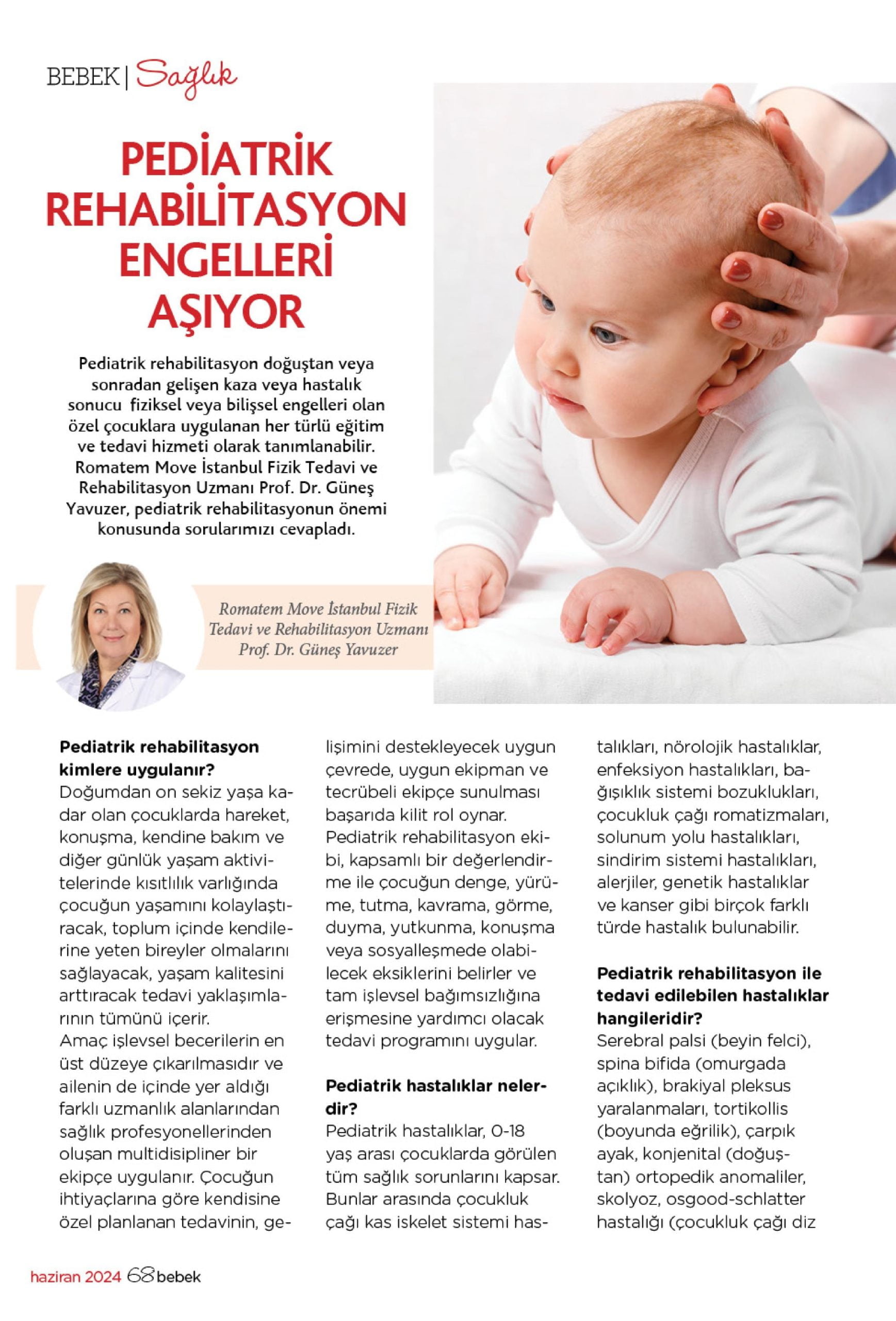
BABY | SoMJb PEDIATRIC REHABILITATION BREAKS BARRIERS Pediatric rehabilitation can be defined as all kinds of education and treatment services applied to special children with physical or cognitive disabilities as a result of congenital or acquired accident or disease. Romatem Move Istanbul Physical Therapy and Rehabilitation Specialist Prof. Dr. Güneş Yavuzer answered our questions about the importance of pediatric rehabilitation. Romatem Move Istanbul Physical Therapy and Rehabilitation Specialist Prof. Dr. Güneş Yavuzer To whom is pediatric rehabilitation applied? Pediatric rehabilitation includes all treatment approaches that will facilitate the child's life, enable them to become self-sufficient individuals in society and improve their quality of life in the presence of limitations in movement, speech, self-care and other activities of daily living in children from birth to eighteen years of age.
The aim is to maximize functional skills and is applied by a multidisciplinary team consisting of health professionals from different fields of expertise, including the family. The key to success is that the treatment, which is tailored to the needs of the child, is provided by the appropriate equipment and experienced team in the appropriate environment to support its development. The pediatric rehabilitation team determines the child's deficiencies in balance, walking, holding, grasping, vision, hearing, swallowing, speaking or socialization with a comprehensive evaluation and applies the treatment program to help the child achieve full functional independence.
Pediatric Rehabilitation Breaks Barriers
What are pediatric diseases? Pediatric diseases include all health problems seen in children between the ages of 0-18. These include childhood musculoskeletal diseases, neurological diseases, infectious diseases, immune system disorders, childhood rheumatism, respiratory diseases, digestive system diseases, allergies, genetic diseases and cancer. Which diseases can be treated with pediatric rehabilitation? Cerebral palsy, spina bifida, brachial plexus injuries, torticollis, clubfoot, congenital orthopedic anomalies, scoliosis, osgood-schlatter disease (childhood knee June 2024 63bebekProviding the treatment planned specifically for the child according to his/her needs, in an appropriate environment that will support his/her development, with appropriate equipment and an experienced team plays a key role in success. pain), paralysis that may develop after childhood infections, cancer or accidents, balance, walking, speech disorders, hemophilia and joint problems that develop after childhood inflammatory joint rheumatism can benefit from pediatric rehabilitation approaches.
What are the treatment methods used in pediatric rehabilitation? The most effective method used in pediatric rehabilitation is therapeutic exercises. Physical therapy methods such as in-water exercises, occupational therapy, speech and swallowing therapy, sensory integration, approaches to support cognitive functions, space therapy, electrotherapy, various injections, assistive devices and surgical treatments are used when necessary. The effectiveness of therapeutic exercises and the child's compliance are increased with robots, computer games and virtual reality technology. With neurodevelopmental and therapeutic exercises, we aim to help children gain muscle strength, balance and coordination, keep muscle tone under control, and prevent the development of joint movement limitation and bone deformity. The correct use of muscles is necessary not only for the healthy development of the musculoskeletal system in accordance with the age of the child, but also for cognitive development and socialization. Even standing with a simple standing stand makes a great contribution to the child's motor and mental development. In order to get more effective results with rehabilitation, it is very important to start treatment early and continue it regularly.
Follow-up and early diagnosis of low birth weight and high-risk babies increases treatment success. At this point, parents have important duties. Following the development of their children closely and being in contact with their doctors by taking into account the problems they encounter facilitates early diagnosis and treatment. In 1-month-old babies; sucking problems, no reaction to stimuli from the environment, continuous and uninterrupted crying bouts, very frequent and severe vomiting, in 2-month-old babies; sucking problems, no reaction to stimuli from the environment, continuous and uninterrupted crying spells, very frequent and severe vomiting, convulsions, looseness or excessive stiffness in the muscles in 3-month-old babies; shifting and twitching of the eyes, contraction and discomfort when lying on the back, not starting to laugh, not recognizing the mother, not looking at the face of the speaker in 4-month-old babies; In 8-month-old babies; not being able to turn and move on their own, not developing hand coordination skills, kicking with both legs, collapsing the body on the legs while sitting; not being able to sit, crawl, stand up, not responding to his/her name, in a 12-month-old baby; not starting to walk even by holding on. Which robotic devices do you get support from in the pediatric rehabilitation process?
In addition to traditional physical therapy and rehabilitation practices consisting mainly of therapeutic exercises, we use rehabilitation robots to elicit active movement in the arm and leg, to support voluntary motor control, and to improve holding, grasping, balance and walking. We benefit greatly from treatment methods that are made fun and effective with virtual reality and computer games to improve physical and cognitive functions.